How Much Does a Small Business Website Actually Cost in 2026?
"How much does a website cost?" is one of those questions that has no honest single-number answer — and anyone who gives you one before asking what you actually need is guessing. A small business can spend nothing but time on a DIY builder, a few hundred dollars on a freelancer, several thousand on a local designer, or tens of thousands on a full-service agency, and all four of those businesses will end up with something that could reasonably be called "a website."
This post isn't a pitch. It's a market survey — what the different paths actually cost, what you get at each price point, and the line items almost everyone forgets to budget for. At the end, I'll tell you honestly where GCP sits in this spectrum, but the goal here is to make you a smarter buyer no matter who you end up hiring.
Why the Same Question Gets a 10x Range of Answers
Three variables explain almost all of the spread between a $200 website and a $20,000 one:
- Scope. A five-page brochure site with a contact form is a fundamentally different project than a site with online booking, a searchable service catalog, e-commerce checkout, or custom integrations to a CRM or scheduling tool. Pages are the least important cost driver — functionality is.
- Who's doing the work. Your own hours, a freelancer's hours, or a small team's hours all get priced differently, and the hourly rate roughly tracks experience and overhead. A solo freelancer with no office and no employees can charge less than an agency with account managers, project coordinators, and rent — that's not a red flag, it's just a different cost structure.
- What's included after launch. A price that only covers the build looks cheap next to a price that includes a year of hosting, security updates, and edits. Compare total cost of ownership, not just the sticker price on day one.
Keep those three variables in mind as you read the ranges below — they're the reason two business owners can ask the same question and get quotes that differ by an order of magnitude, and both quotes can be legitimate.
DIY Builders — and the Hidden Cost of Your Own Hours
Platforms like Wix, Squarespace, GoDaddy Websites + Marketing, and Shopify (for stores) let you build a site yourself for a monthly subscription that typically runs somewhere in the high-teens to low-hundreds of dollars a month, depending on the plan tier and whether you need e-commerce features. On paper, this is the cheapest option by a wide margin.
The part that doesn't show up in the pricing page: your own time. Picking a template, writing every page of copy, sourcing and licensing photos, learning the editor's quirks, and getting the mobile layout to not look broken is a real project — realistically dozens of hours spread across several weekends for most owners doing it for the first time. If you value your own time at even a modest hourly rate, the "free" or "cheap" DIY route often isn't actually the cheapest option once you account for the hours you didn't spend running your business instead. That doesn't make DIY the wrong choice — for some businesses it's genuinely the right one — but it's not a fair comparison unless you count the hours.
Freelance Marketplaces
Sites like Fiverr, Upwork, and Freelancer.com connect you to independent designers and developers worldwide, with prices ranging from a few hundred dollars for a bare-bones template site to well into four figures for something more custom. The range on these platforms is enormous because the talent pool is enormous — you're just as likely to find someone excellent as someone who disappears halfway through.
The real risk isn't usually the sticker price — it's what happens after delivery. Marketplace gigs are typically priced for the build, not for ongoing support. If your contact form stops sending leads six months later, or you need a phone number updated, there's often no one on the other end unless you negotiate that separately or pay for a new gig.
Local Freelancers and Independent Designers
An independent web designer in your area — someone you can meet for coffee, not just message through a platform — typically quotes per project, and a straightforward small business site (five to ten pages, a contact form, mobile-responsive design) commonly lands somewhere in the low-to-mid thousands. More custom functionality pushes that higher.
The upside is real: local accountability, a phone number that gets answered, someone who understands your market. The downside is also real — you're often a single point of failure. If they get busy with other clients, move on to a different career, or simply stop responding, you may be stuck with a site nobody can update until you find someone new to reverse-engineer it.
Small Agencies and Boutique Studios
A small agency or boutique studio — usually a handful of people rather than a solo operator — typically prices a professionally designed multi-page site well into the low-to-mid four figures and up, depending on scope. What you're paying for beyond the design itself is process: a project manager who keeps things on schedule, a copywriter who isn't you, a designer whose full-time job is making small business sites look credible, and a team that doesn't vanish if one person is out sick.
This tier is often the sweet spot for a business that wants something that looks and functions like it was built by professionals, without the overhead of a large agency's account-management layer.
Full-Service and Enterprise Agencies
Larger agencies and digital consultancies serving enterprise or well-funded mid-market clients routinely quote well into five figures — sometimes well beyond that for sites with heavy custom development, complex third-party integrations, or multi-stakeholder approval processes. That price reflects real overhead: account teams, discovery workshops, design systems, QA processes, and the layers of review that larger organizations require.
For most small businesses reading this, this tier is more infrastructure than the situation calls for. It's the right fit for a company with a marketing department and a multi-step internal sign-off process — not for an owner-operator who needs a site that generates calls and looks legitimate.
The Costs Everyone Forgets to Budget
Whichever path you take, these line items show up whether or not they were in the original quote:
| Line Item | What to Expect |
|---|---|
| Domain registration | A modest annual fee, renewed every year for as long as you own the site. Easy to forget it's recurring, not one-time. |
| Web hosting | Ranges from a few dollars a month for basic shared hosting to considerably more for managed hosting with better performance and support. |
| SSL certificate | Often bundled free with modern hosts, but some providers still charge separately — worth confirming before you assume it's included. |
| Premium theme or plugin licenses | A one-time or annually renewed fee for anything beyond the free tier — booking widgets, advanced forms, page builders. |
| Stock photography | Licensed per image or through a subscription if you don't have your own professional photos — a real cost most quotes leave as "TBD." |
| Copywriting | If you're not writing the site yourself, professional copywriting is typically priced per page and adds up fast on a multi-page site. |
| Ongoing edits | The one that surprises people most: many freelancers and agencies bill an hourly rate for anything after launch — a phone number change, a new photo, a seasonal promotion — and those small requests accumulate into a real recurring cost. |
That last row is the one worth sitting with. A website isn't a purchase you make once — it's an asset you keep updating for as long as you use it. A vendor who prices the build cheap and bills every change afterward at an hourly rate can end up costing more over two years than a vendor who quoted higher upfront with edits included.
Where GCP Sits in This Market
Here's the honest answer, since this is the part where most posts like this pivot into a sales pitch: GCP builds small business websites from $650 one-time, plus from $149/month that covers hosting, SSL, domain management, security patching, backups, uptime monitoring, and ongoing content edits — one monthly fee, nothing billed separately later.
Price-wise, that puts the build cost toward the lower end of the local-freelancer tier described above. What's different is the ongoing-cost structure: instead of a cheap build followed by hourly billing for every change, the monthly fee is designed so there's no separate invoice for hosting renewal, an SSL certificate, a plugin license, or a small content update. You can see the full breakdown of what's included on the pricing and care plan page, and the web design overview covers the build process end to end.
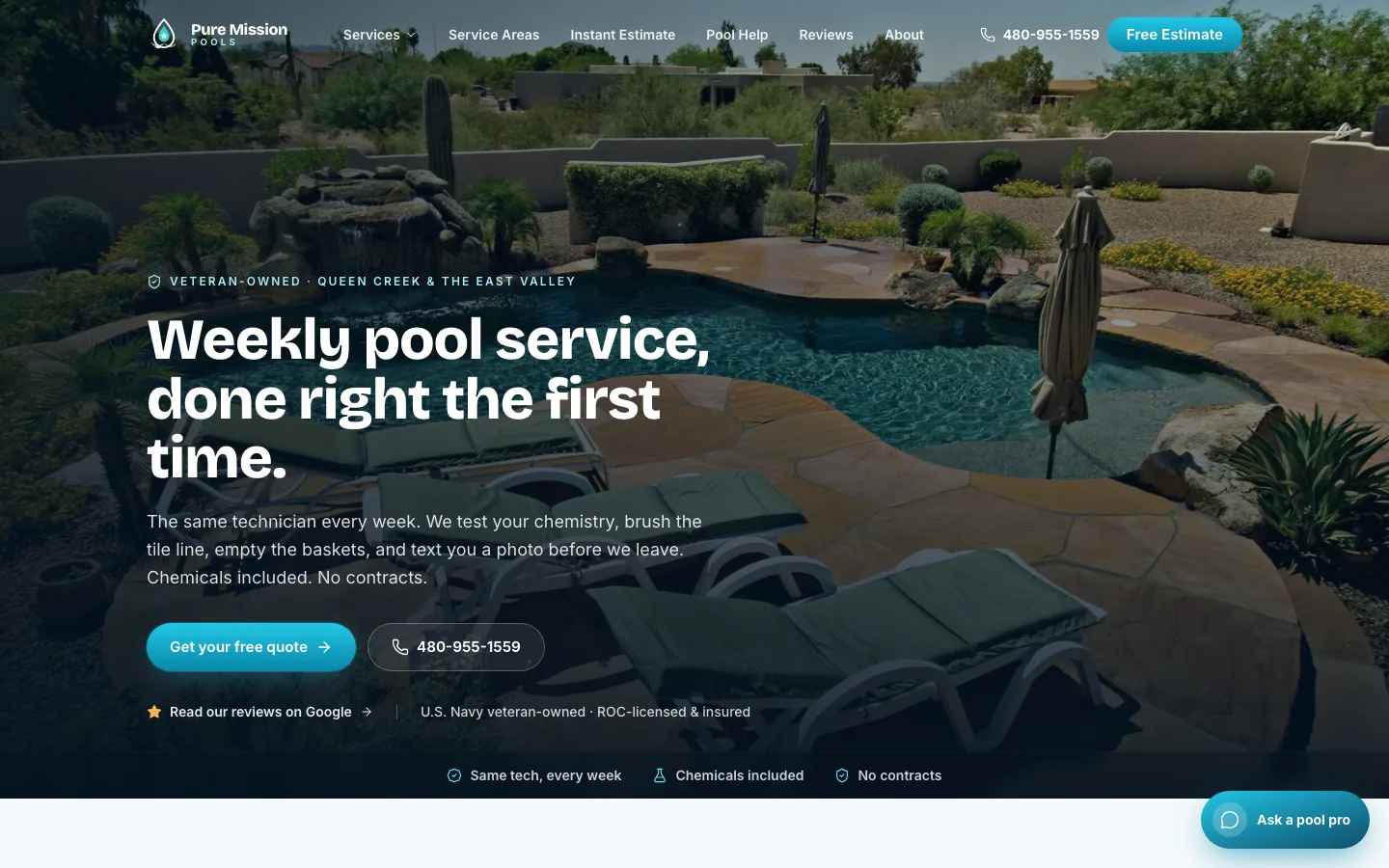
This is also where the GCP portfolio is worth a look — Pure Mission Pools, a real Phoenix-metro client, is the clearest example of what the build actually produces: a mobile-first site with local landing pages, lead-capture forms, and tools built for a service business, not a template with the logo swapped out.
If you're a Phoenix-metro service business — a pool company, a plumber, an HVAC contractor, a landscaper — the pool service website design and other trade pages break down exactly what those sites need to include. If you're specifically looking for a local team, the Phoenix web design page covers what GCP builds for businesses in the Valley.
Getting a Real Number for Your Situation
Whoever you end up hiring, ask these questions before you sign anything — they'll surface the gap between the quote and the real total cost faster than anything else:
- Does this price include hosting, SSL, and a domain, or are those separate?
- Who owns the domain and hosting account when the project is done — you or the vendor?
- What happens when I need a small change six months from now — is that included, or billed hourly?
- What's the realistic timeline, and what happens to that timeline if I'm slow to provide content?
- If something breaks — the form stops emailing me, the site goes down — who fixes it, and how fast?
A vendor who answers these clearly and specifically, before you've signed anything, is a good sign regardless of which price tier they're in. A vendor who gets vague about anything past "launch day" is telling you something important about what happens after they cash the first check.
If you want to compare the DIY route against a custom build in more detail — including when a builder like Wix is genuinely the right call — read Wix vs. WordPress vs. Custom. And if the ongoing-cost line item above is the part you want to understand better, What a Website Maintenance Plan Should Actually Include breaks down exactly what "maintenance" should mean before you pay for it.
Want an Honest Number for Your Business?
GCP builds small business websites from $650, from $149/month covering hosting, updates, and support. No separate invoices for hosting renewal or small edits.