We don't just consult on AI — we ship it. Two of our own AI products and a client build are live right now, each handling real users, real data, real traffic. This is the work.
↓ Scroll to see the build stories
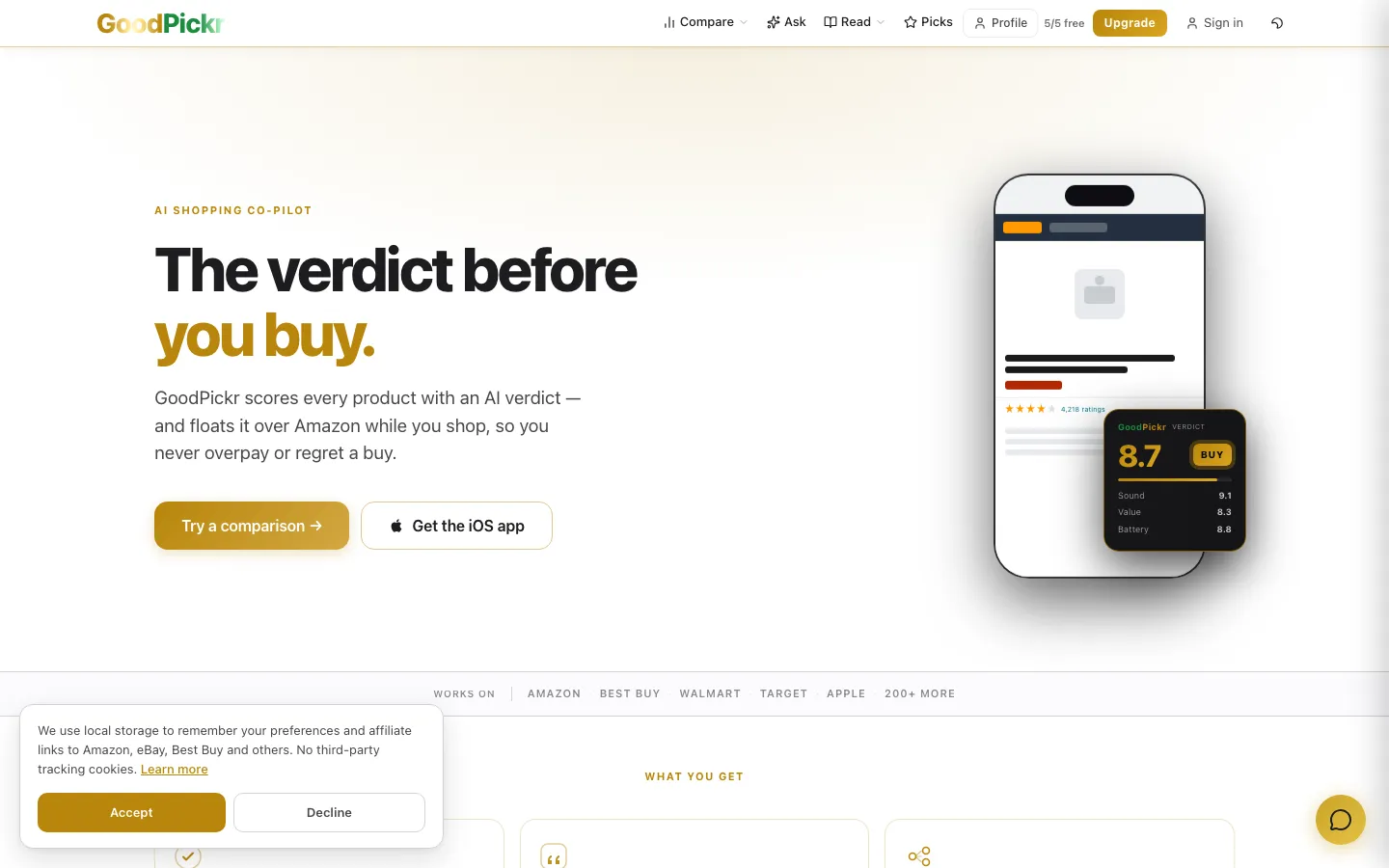
AI-powered product comparison — for anything.
Built solo, GoodPickr lets anyone compare any two products with streaming AI analysis powered by Claude. The engine parses Amazon's catalog by ASIN, verifies product images with vision models, and returns curated "top picks" across thousands of categories — all in seconds.
Available as a web app, iOS native app (SwiftUI), and macOS app. Same product comparison engine, three surfaces.
Product comparison sites are static, ad-bloated, and out-of-date by the time you read them. There's no way to compare "the best X for Y use case" without trawling 8 tabs of Reddit threads written six months ago.
Streaming AI picks driven by Claude, anchored to real Amazon products via ASIN extraction. Vision-vet every image so what you see is what you'd actually buy. Ship the same engine to web, iOS, and macOS — one backend, three surfaces.
A live product handling real comparisons every day. iOS app in TestFlight. Search-indexed long-tail categories across thousands of niches. Built and operated by one engineer, without the overhead of a team.
Find a church near you — with real data, not directories.
Most church finders are stale directories of dead links. NearFaith uses live Google Places data, denominational filters, and AI-generated city guides to make church discovery actually useful.
Every U.S. city has a dedicated landing page, every denomination has a hub, and every church has its own structured-data-rich profile — engineered for both human visitors and search-engine indexing.
Church directories are years out of date. Denominational lookup is fragmented. No one is indexing the actual local landscape — just aggregating old lists of names and hoping for the best.
Pull live Google Places data, layer AI-generated city and denomination guides, ship slug-based URLs and structured data so every church is discoverable in Google. Treat SEO as a product feature, not an afterthought bolted on after launch.
50K+ churches indexed across the U.S. AI-generated guides for thousands of cities. Real organic traffic via daily Google indexing pushes. Live at nearfaith.com, and growing every week.
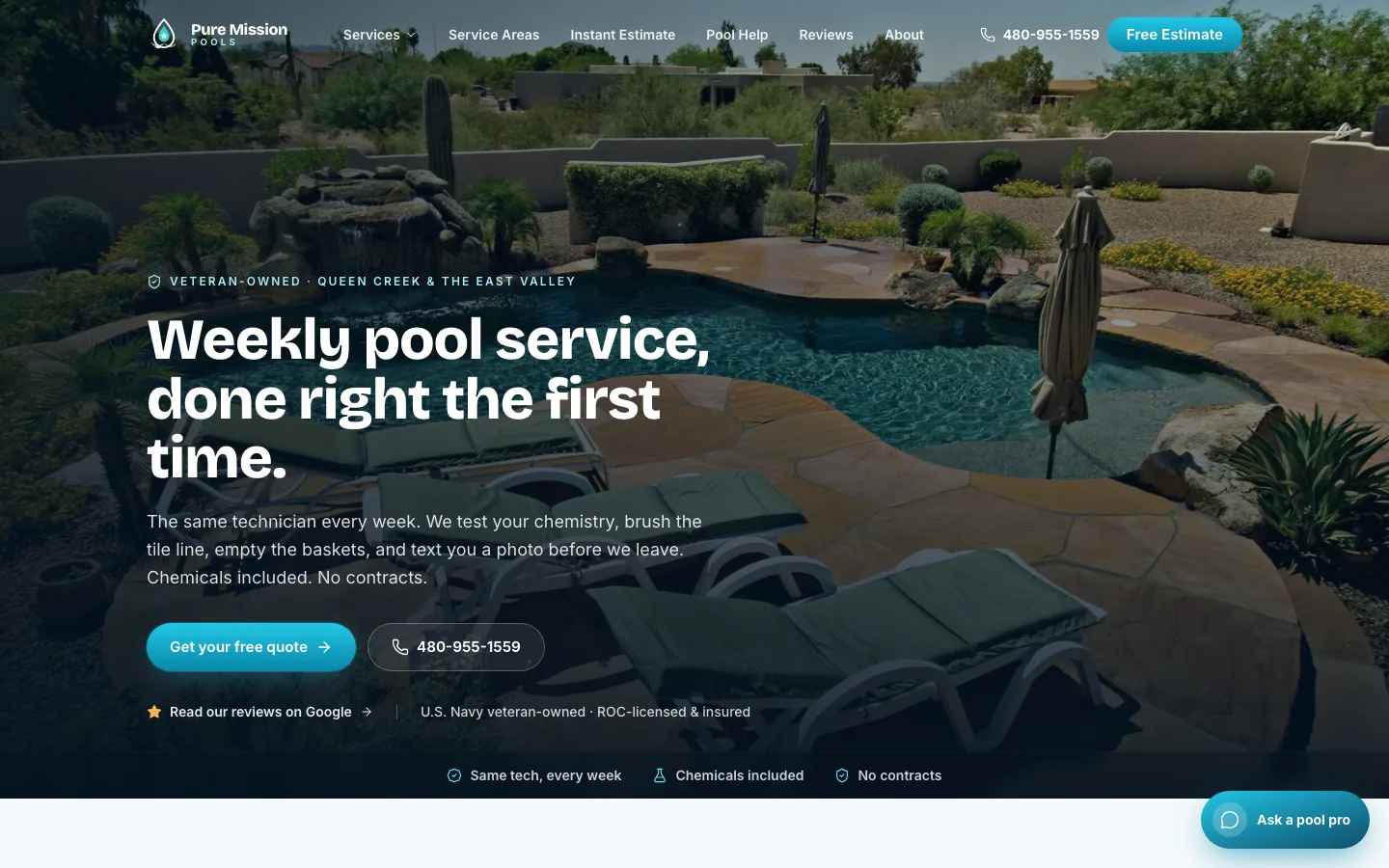
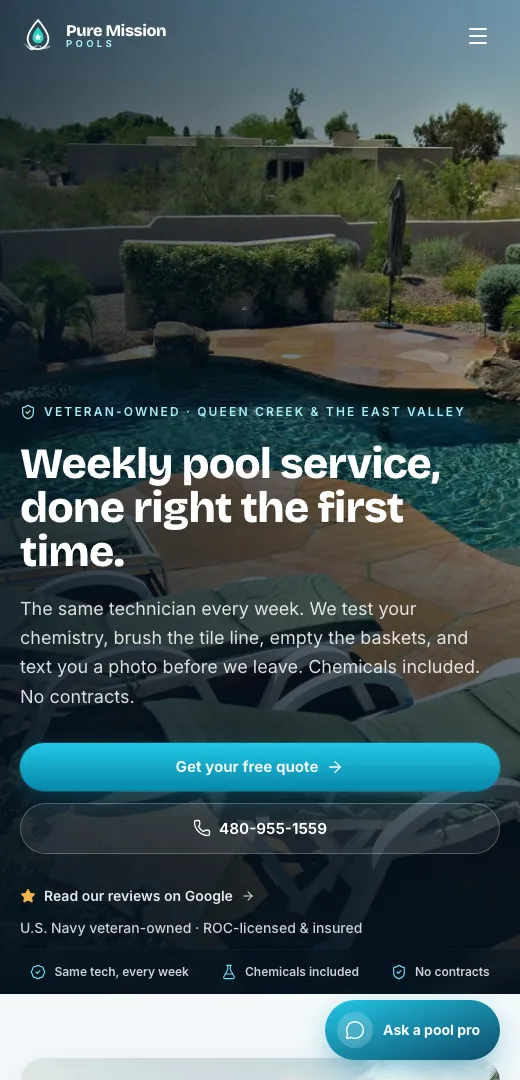
A veteran-owned pool service, rebuilt as an AI-powered lead engine.
A Queen Creek pool company needed more than a brochure site — so we shipped a conversion-first web app with AI in the core, not bolted on. An instant AI estimate quotes weekly service in seconds, and an on-site "pool pro" assistant answers water-chemistry questions in plain language.
Underneath, 36 programmatic city-by-service landing pages blanket the East Valley for local search — each cross-linked and sitemap-indexed — with every lead routed straight to the owner's inbox.
Local service businesses live or die by the phone ringing — but most sites are static brochures. No way to capture a lead at 11pm, no answers on demand, no follow-up. Word-of-mouth doesn't scale, and neither does a page that just lists a phone number.
Put AI where it earns its keep: an instant-estimate quote flow and a natural-language pool assistant, both wired to email every lead to the owner. Then blanket local search with programmatic city × service pages, so the site turns up before a competitor's does.
A production site on its own domain, three AI tools running on a single model key, and 36 SEO pages indexed and cross-linked. A brochure became a 24/7 lead engine — designed, built, and shipped by GCP for a real client.
These aren't toy demos or side projects wrapped in a landing page. They're production systems, built to the same standard we bring to every client engagement.
Production deploy on day 5, not month 5. We build live, in public, and iterate from real usage — because real feedback beats imagined requirements every time.
LLMs are routed, cached, fallbacked, and vision-vetted. Not "we wrapped GPT-4" — actual production AI plumbing with real error handling, token economics, and model diversity.
Google Places, Amazon ASINs, indexed church records — never synthetic. Real data is the moat. Anyone can generate fake content; sourcing and structuring real data at scale is the hard part.
Structured data, slug-based URLs, sub-1s loads. Indexed by Google in days, not months. We engineer discoverability in from the start — not as a retrofit when traffic doesn't show up.
Whether you need an AI product shipped from zero, or D365 CE expertise from a team that actually builds, we're available for selective engagements.